



Best ways to get leads for a small business in 2027
Ads, Google, reviews, referrals or AI search? A plain 2027 guide to where small business leads really come from, and the order to set them up in.

Most small businesses do not have a lead problem. They have a leak.
People find them, look around, and leave without calling. Or they call, and nobody picks up for a day. Then the owner decides marketing does not work and buys more ads.
This guide covers the channels that bring leads in 2027, and the order to set them up in. Do them in this order and every dollar you spend later works harder.
Key points
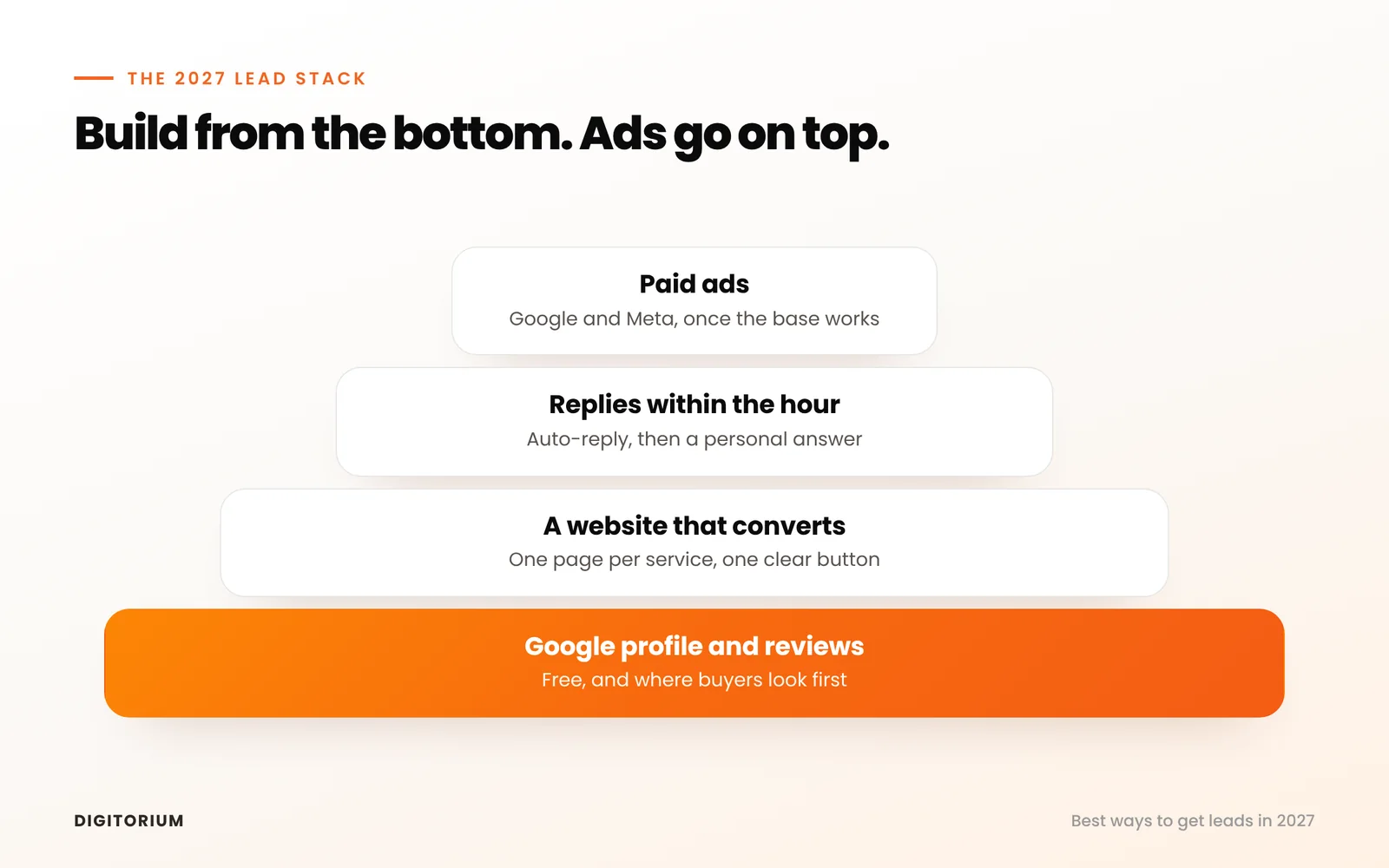
Start where buyers already look: your Google Business Profile and your reviews.
Your website is where most people decide. Give each service its own page and one clear next step.
Reply within the hour. Fast follow-up turns more inquiries into customers than any new channel.
Add paid ads once the basics work, so you are not paying to send people to a leak.
1. Own your Google Business Profile
When someone searches for a service "near me", Google shows a map with a few businesses before any website. Those businesses come from Google Business Profile.
Google says local results are mainly based on relevance, distance and prominence. It also says businesses with complete and accurate information are more likely to show up.
Yet BrightLocal's 2026 research found that just 35% of small businesses have a Google Business Profile. That is your opening.
Claim it, verify it, pick the right category, and fill in every field. Add photos every month.
2. Collect reviews every week
97% of consumers read reviews for local businesses, according to BrightLocal's Local Consumer Review Survey 2026. Almost half (47%) will not use a business with fewer than 20 reviews.
Recency matters too. 74% only care about reviews from the last three months.
So ask every happy customer, every week, with a direct link. Reply to every review, good or bad. 89% of consumers expect owners to respond.
Never buy reviews or offer anything in return for a good one. The FTC banned fake and incentivized reviews in 2024.
3. Make your website do the selling
After reading positive reviews, 54% of consumers go to the business's website. BrightLocal found that only 40% of local businesses have one.
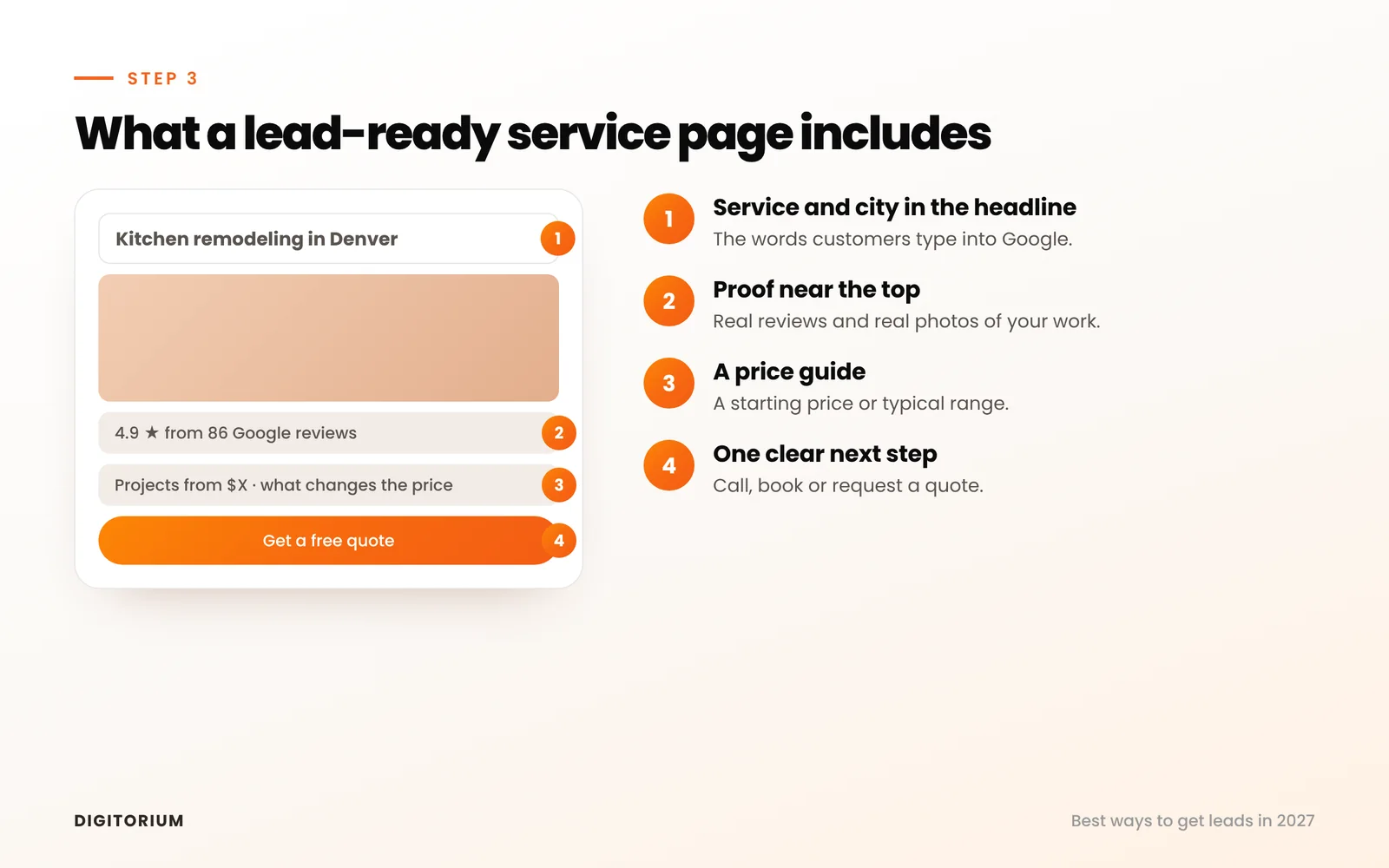
A website that converts is simple:
One page per service, written the way customers search.
Your city and service area named clearly.
Real photos and real reviews.
One clear button: call, book or request a quote.
4. Reply within the hour

This is the cheapest lead win there is.
In a study of 1.25 million leads published in Harvard Business Review, firms that contacted a lead within an hour were nearly 7 times as likely to qualify it as firms that waited longer. After 24 hours, they were 60 times less likely.
Set up an instant auto-reply, a phone number that gets answered, and a rule that every inquiry gets a personal reply the same hour during working time.
5. Show up in AI answers
People now ask ChatGPT and Google's AI for recommendations. BrightLocal's 2026 survey found 45% of consumers use ChatGPT or other AI tools for local recommendations, up from 6% a year earlier.
The good news: the basics above feed AI answers too. In BrightLocal's study of 200,000 local AI searches, business websites made up 42% of all citations, and Google Business Profile 28.5%.
6. Then add paid ads
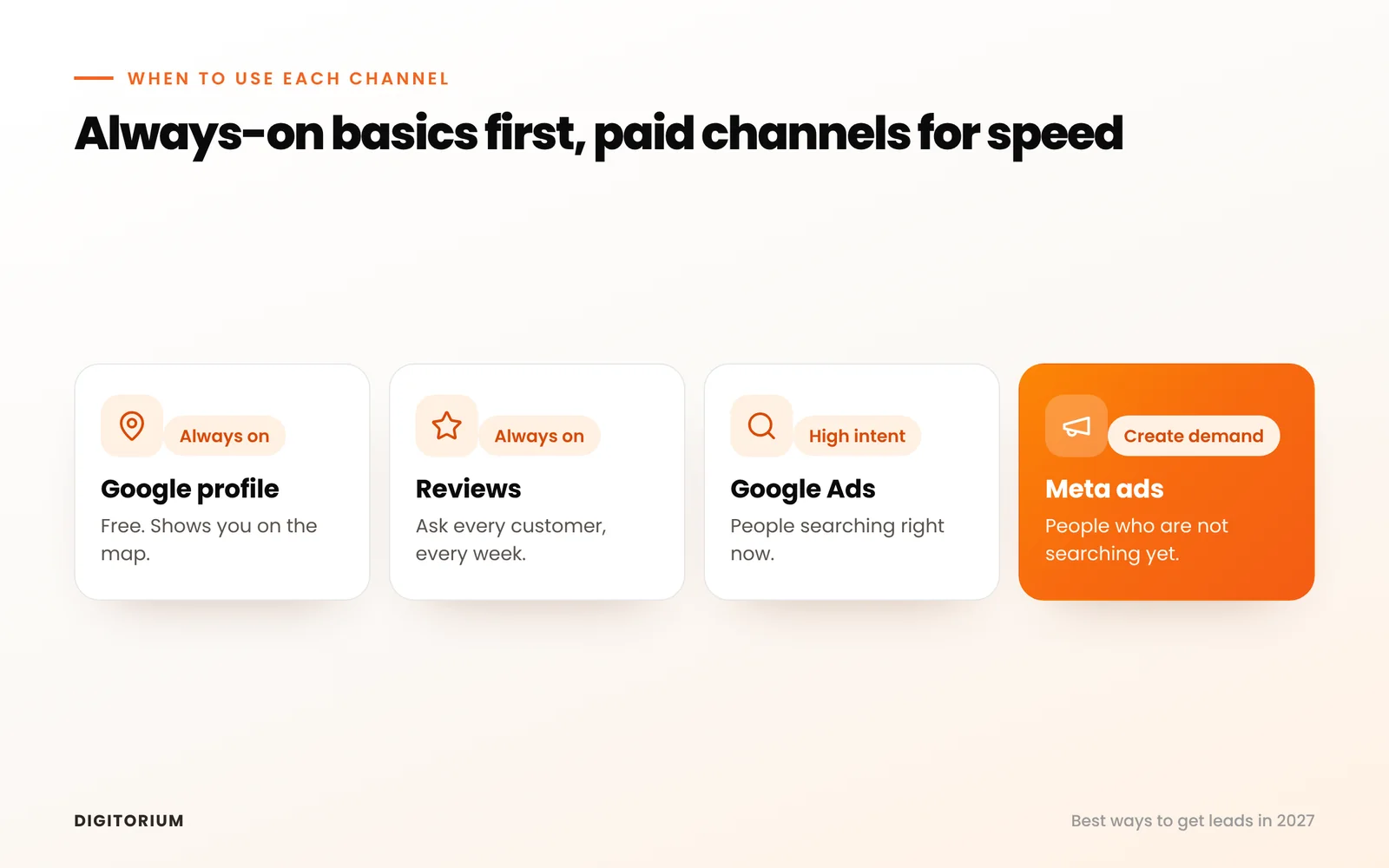
Once the base is solid, ads speed things up.
Google Ads catch people already searching for your service. In WordStream's 2025 benchmarks, the median cost per lead across industries was $70.11.
Meta ads (Facebook and Instagram) create demand with people who are not searching yet. WordStream's 2025 average cost per lead for lead campaigns was $27.66.
Those are cross-industry figures. Your cost will depend on your market, offer and follow-up.
Quick answers
What is the fastest way to get leads?
Paid ads bring leads fastest, often within days. They work best once your profile, reviews, website and follow-up are in place.
What is the cheapest way to get leads?
Your Google Business Profile and reviews. Both are free. They take time each week, not money.
Do I need a website if I have a Google profile?
Yes. More than half of people who read good reviews go on to check the website. Without one, many of them stop there.
Cover photo: Vitaly Gariev on Unsplash.
Sources
Google Business Profile Help, tips to improve your local ranking
Harvard Business Review, The short life of online sales leads
Read next: our case studies, with the numbers included.
Not sure where your leads are leaking?
Send us your website or your ad account. We will tell you where the money is leaking, before you pay us anything.
Want this working for your business?
Send us your site or your ad account. We will tell you where the money is leaking, before you pay us anything.
Get in touch